Wednesday, April 8, 2026

Mastering English Grammar: A Complete Guide for Learners


What is English Grammar?

English grammar is the system of rules that governs how words are used to form sentences. It helps ensure clarity, coherence, and accuracy in communication. Grammar covers parts of speech, sentence structure, punctuation, and the correct use of tenses, among other things.

Key Components of English Grammar

1. Parts of Speech

Words in English fall into different categories called parts of speech. These are the building blocks of sentences:

  • Nouns – Names of people, places, things, or ideas (e.g., dog, city, happiness).
  • Pronouns – Replace nouns to avoid repetition (e.g., he, she, it).
  • Verbs – Indicate action or state of being (e.g., run, is, feel).
  • Adjectives – Describe nouns (e.g., beautiful, tall, intelligent).
  • Adverbs – Describe verbs, adjectives, or other adverbs (e.g., quickly, very, well).
  • Prepositions – Show relationships between nouns/pronouns and other words (e.g., in, on, at).
  • Conjunctions – Connect words, phrases, or clauses (e.g., and, but, because).
  • Interjections – Express emotion (e.g., Wow!, Ouch!)

2. Sentence Structure

A proper sentence generally contains a subject (who or what) and a predicate (what is said about the subject).

  • Simple sentence: She reads every day.
  • Compound sentence: She reads every day, and she writes in her journal.
  • Complex sentence: Although she is busy, she reads every day.

3. Tenses

Tenses indicate the time of an action. There are three main categories:

  • Present Tense: I eat.
  • Past Tense: I ate.
  • Future Tense: I will eat.

Each tense has variations like continuous, perfect, and perfect continuous to express nuances of time.

4. Punctuation

Punctuation marks help structure sentences and clarify meaning:

  • Period (.) – Ends a statement
  • Comma (,) – Separates items or clauses
  • Question mark (?) – Ends a question
  • Exclamation mark (!) – Expresses strong emotion
  • Apostrophe (’) – Shows possession or contraction
  • Colon (:) and Semicolon (;) – Connect related ideas

5. Common Grammar Mistakes

Even advanced learners make mistakes. Watch out for:

  • Subject-verb agreement: He go to school → He goes to school.
  • Incorrect tense usage: I am went to the store → I went to the store.
  • Misplaced modifiers: She almost drove her kids to school every day → She drove her kids to school almost every day.

Tips to Improve Your Grammar

  1. Read regularly – Exposure to proper grammar improves instinctive usage.
  2. Write daily – Practice writing sentences, paragraphs, or even a journal.
  3. Learn rules gradually – Don’t try to memorize everything at once. Focus on one aspect at a time.
  4. Use grammar tools – Online tools can highlight errors and explain corrections.
  5. Engage in conversation – Speaking with fluent users reinforces correct structures.

Conclusion

English grammar is the backbone of effective communication. Mastering it takes time, practice, and patience, but the payoff is enormous. With consistent effort, you can write and speak English with clarity, confidence, and precision.


References :

https://youtu.be/vHoTJuf4aqA?si=ij0WBzHcaZDo85Zx

https://youtu.be/DHk0EWevpk0?si=GrwBhq_Y96VKw5RM

https://youtu.be/jBUklI7YlYQ?si=g9WxcB2HnzRXhP2u

🍕 Understanding Fractions – A Simple and Fun Guide


Fractions


🌟 Introduction

Fractions are an important part of mathematics that we use in our everyday life. Whether you are sharing a pizza, dividing chocolates, or measuring ingredients while cooking, fractions help us describe parts of a whole.

In this blog, we will explore what fractions are, their types, and how to solve simple problems using fractions in an easy and fun way!

🍰 What is a Fraction?

Fractions represent a part of the whole. It represents the number of parts of a certain number, size, or collection compared to the total number of equal parts. 

Notation

A number is written in the fractional form as   a / b 

⇒ Numerator / Denominator

Examples

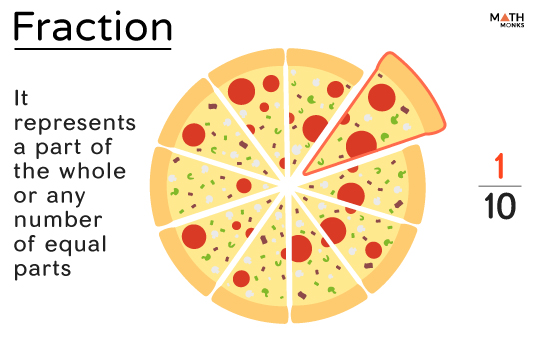
If a pizza is cut into ten equal slices and one slice of the pizza is placed on a dish, then each dish is said to have  of the pizza. It is read as ‘one-tenth’ or ‘1 by 10.’

Fractions

Parts

A fraction consists of two main parts: a numerator and a denominator, separated by a horizontal bar known as the fraction bar.

Numerator

The numerator is the top number above the fraction bar, indicating how many parts we have. 

Denominator

The denominator is the number below the fraction bar, which shows how many equal parts the whole is divided into.

The diagram below shows the different parts of the fraction  1/10

Why Fractions Matter

Fractions are everywhere:

  • Cooking: ½ cup of sugar, ¾ teaspoon of salt.
  • Time: ¼ of an hour is 15 minutes.
  • Money: ¾ of $20 is $15.
  • Measurement: ⅔ meter of cloth.

Types of Fractions:

1. Proper Fractions: The numerator is smaller than the denominator (e.g., 2/5). These fractions are always less than 1.

2. Improper Fractions: The numerator is equal to or greater than the denominator (e.g., 7/4). These fractions are equal to or greater than 1.

3. Mixed Numbers: A combination of a whole number and a proper fraction (e.g., 1 3/4).

4. Like Fractions: Fractions that have the same denominator are called like fractions.

          Example: 2/5, 3/5, 4/5

5. Unlike Fractions: Fractions that have different denominators are called unlike fractions.

          Example: 1/3, 2/4, 5/6

6. Equivalent Fractions: Different fractions that represent the same value (e.g., 1/2 = 2/4 = 4/8). You can find them by multiplying or dividing the numerator and denominator by the same number.

Conclusion

Fractions might seem tricky at first, but they’re simply a way to describe parts of a whole. With practice and visualization, anyone can master fractions. Remember, fractions are not just numbers—they are a tool for understanding the world around us.


References: 

https://youtu.be/N3__8MmaiLE?si=8R8faXYL994RXu0A


https://youtu.be/362JVVvgYPE?si=BQmY4tiXpK_iewnN


Wednesday, April 1, 2026

Transform Your Life with Yoga Development

 Introduction to Yoga


Yoga is an ancient practice that originated in India and focuses on achieving harmony between the body, mind, and soul. The word “yoga” means union, symbolizing the connection of physical, mental, and spiritual well-being. It is not just a form of exercise but a way of living a healthy and balanced life.

Yoga includes various practices such as asanas (physical postures), pranayama (breathing techniques), and meditation (dhyana). These practices help improve flexibility, strength, concentration, and inner peace. Regular practice of yoga reduces stress, enhances mental clarity, and promotes overall health.

🧘‍♀️ Surya Namaskar (Sun Salutation) 🌄

☀️ Introduction

Surya Namaskar is a sequence of 12 yoga postures performed in a flow. It is a complete exercise that improves physical fitness, flexibility, and mental focus.

Procedure (12 Steps)

  1. Pranamasana – Stand and join hands in prayer position
  2. Hastauttanasana – Raise arms and bend slightly backward
  3. Padahastasana – Bend forward and touch feet
  4. Ashwa Sanchalanasana – Take one leg back, look upward
  5. Dandasana – Take the other leg back (plank position)
  6. Ashtanga Namaskara – Knees, chest, chin touch the floor
  7. Bhujangasana – Raise chest (cobra pose)
  8. Parvatasana – Raise hips (mountain pose)
  9. Ashwa Sanchalanasana – Bring one leg forward
  10. Padahastasana – Bend forward
  11. Hastauttanasana – Raise arms backward
  12. Pranamasana – Return to prayer position

⚠️ Precautions

  • Avoid if you have heart problems or severe back pain
  • Practice slowly and do not overstrain
  • Consult a doctor if you have medical conditions

🌿 Therapeutic Values

  • Improves flexibility and strengthens muscles
  • Enhances blood circulation and digestion
  • Reduces stress and increases energy


🧘‍♀️ Five Important Yoga Asanas

1. Tadasana (Mountain Pose)

Tadasana is a basic standing posture where the body is stretched upward. It helps improve posture, balance, and strengthens the legs and spine. It also increases body awareness.

2. Vrikshasana (Tree Pose)

In this pose, one leg is balanced while the other foot is placed on the inner thigh. It improves concentration, stability, and strengthens the legs and core muscles.

3. Bhujangasana (Cobra Pose)

This is a back-bending pose where the chest is lifted while lying on the stomach. It strengthens the spine, opens the chest, and improves flexibility.

4. Paschimottanasana (Seated Forward Bend)

In this pose, the body bends forward to touch the toes while sitting. It stretches the spine and hamstrings, improves digestion, and calms the mind.

5. Balasana (Child’s Pose)

A resting pose where the body is bent forward while sitting on the heels. It relaxes the body, reduces stress, and gently stretches the back.

✅ These asanas together help in improving flexibility, strength, balance, and mental relaxation.


🧘‍♀️ Pranayamas : 🧘‍♂️

1. Anulom Vilom Pranayama

A breathing technique where you inhale through one nostril and exhale through the other alternately. It helps in calming the mind and improving breathing.

2. Nadi Shodhana Pranayama

This is a purification breathing technique similar to alternate nostril breathing. It helps balance the nervous system and improves concentration.

3. Bhramari Pranayama (Bee Breathing)

In this pranayama, you make a humming sound while exhaling. It reduces stress, anger, and promotes mental peace.

4. Kapalbhati Pranayama

A forceful exhalation technique where inhalation happens naturally. It helps in detoxifying the body and improving digestion.

5. Bhastrika Pranayama

A rapid breathing technique involving quick inhalation and exhalation. It increases energy levels and improves lung capacity.

✅ These pranayamas help in improving breathing, reducing stress, and enhancing overall health.

Yoga Mudras with simple explanations 🧘‍♂️

1. Gyan Mudra (Mudra of Knowledge)

Join the tip of the thumb and index finger, keeping other fingers straight.
👉 Helps improve concentration, memory, and mental clarity.

2. Prana Mudra (Mudra of Life Energy)

Join the tips of the thumb, ring finger, and little finger.
👉 Increases energy, boosts immunity, and reduces fatigue.

3. Chin Mudra (Mudra of Consciousness)

Touch the thumb and index finger while keeping palms facing upward on the knees.
👉 Promotes calmness, meditation, and inner peace.

🧘‍♂️ Dhyanam (Meditation)

Procedure – 1 Point

Sit in a comfortable position, close your eyes, focus on your breath or a single point, and remain still.

⚠️ Precautions – 1 Point

Avoid forcing concentration and practice in a quiet, comfortable place.

🌿 Therapeutic Values – 1 Point

Reduces stress and improves mental clarity.

💭 Reflections – 1 Point

Creates inner peace, calmness, and better concentration.

🌿 More Therapeutic Values

  1. Improves memory and focus
  2. Helps control emotions
  3. Promotes better sleep
  4. Enhances mental well-being

💭 More Reflections

  1. Gives a sense of relaxation and stability
  2. Increases self-awareness
  3. Reduces negative thoughts
  4. Creates a peaceful and balanced mind

✅ Dhyanam helps in achieving harmony between mind, body, and soul.


🧘‍♀️ Conclusion on Overall Yoga

Yoga is a holistic practice that promotes harmony between the body, mind, and soul. Through regular practice of asanas, pranayama, and meditation, it improves physical health, mental clarity, and emotional balance. It helps in reducing stress, increasing flexibility, and enhancing overall well-being.

In today’s fast-paced world, yoga acts as a natural way to maintain a healthy lifestyle and inner peace. It develops discipline, self-awareness, and a positive attitude towards life. Overall, yoga is not just an exercise but a way of life that leads to a balanced, healthy, and peaceful existence.


Thursday, February 5, 2026

Effective Classroom Management Strategies for a Positive Learning Environment


                                                        Introduction

Classroom management is the backbone of effective teaching. When done right, it creates a safe, respectful space where students can focus on learning instead of distractions. Let’s break down practical strategies that work.

1. Set Clear Expectations from Day One 📚

- Co-create classroom rules* with students so they feel ownership.

- Explain the “why” behind each rule (e.g., “We raise hands to respect everyone’s turn”).

- Visual reminders like posters help reinforce norms.

2. Establish Daily Routines

- Entry and exit procedures (e.g., bell work, closing reflections).

- Transition signals (e.g., clapping pattern, countdown) to shift focus quickly.

- Consistent materials management (e.g., where to pick up books, submit assignments).

3. Use Positive Reinforcement👍

- Specific praise (“Great job explaining that concept, Rohan!”).

- Non-verbal cues (thumbs-up, stickers) for quick encouragement.

- Reward systems (e.g., “Caught Being Good” jar with small prizes).

4. Build Relationships First 

- Greeting students daily at the door sets a positive tone.

- Learn about their interests to personalize interactions.

- Restorative chats after conflicts (“How can we fix this together?”).

5. Proactive vs. Reactive Strategies

- Circulate the room to nip issues in the bud.

- Pre-correct behaviors (“Remember to use inside voices”).

- Logical consequences (e.g., losing a privilege tied to the rule broken).

6. Leverage Technology Wisely 💻

- Digital behavior trackers (e.g., ClassDojo) for real-time feedback.

- Timers and alerts for smooth transitions (e.g., “5 minutes left”).

- Online etiquette rules if teaching hybrid/virtual classes.

7. Reflect and Adapt 🔄

- Debrief with students (“What worked today? What didn’t?”).

- Adjust strategies based on class dynamics (e.g., tweaking rewards for different age groups).

- Seek peer feedback – colleagues can spot blind spots.

Why It Works?

- Reduces stress for both teachers and students.

- Boosts engagement as learners feel safe and respected.

- Frees up time for actual teaching vs. constant behavior fixes.

Checking and improving 🌟

- How can I watch how students behave and change my plans if needed?

- What are some ways to ask students for ideas on making the classroom better?

- How can I think about my own teaching and make changes to do better?

- How do I know if my classroom is working well?

- What do students think about our classroom?


                                                      ****Thank you****

Mastering English Grammar: A Complete Guide for Learners

What is English Grammar? English grammar is the system of rules that governs how words are used to form sentences. It helps ensure clarity, ...