Fractions

🌟 Introduction
Fractions are an important part of mathematics that we use in our everyday life. Whether you are sharing a pizza, dividing chocolates, or measuring ingredients while cooking, fractions help us describe parts of a whole.
In this blog, we will explore what fractions are, their types, and how to solve simple problems using fractions in an easy and fun way!
🍰 What is a Fraction?
Fractions represent a part of the whole. It represents the number of parts of a certain number, size, or collection compared to the total number of equal parts.
Notation
A number is written in the fractional form as
⇒ Numerator / Denominator
Examples
If a pizza is cut into ten equal slices and one slice of the pizza is placed on a dish, then each dish is said to have
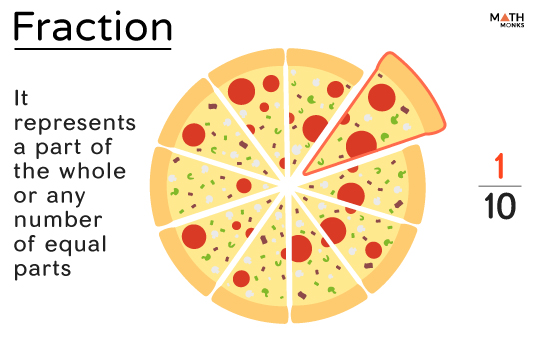
Parts
A fraction consists of two main parts: a numerator and a denominator, separated by a horizontal bar known as the fraction bar.
Numerator
The numerator is the top number above the fraction bar, indicating how many parts we have.
Denominator
The denominator is the number below the fraction bar, which shows how many equal parts the whole is divided into.
The diagram below shows the different parts of the fraction
Why Fractions Matter
Fractions are everywhere:
- Cooking: ½ cup of sugar, ¾ teaspoon of salt.
- Time: ¼ of an hour is 15 minutes.
- Money: ¾ of $20 is $15.
- Measurement: ⅔ meter of cloth.
Types of Fractions:
1. Proper Fractions: The numerator is smaller than the denominator (e.g., 2/5). These fractions are always less than 1.
2. Improper Fractions: The numerator is equal to or greater than the denominator (e.g., 7/4). These fractions are equal to or greater than 1.
3. Mixed Numbers: A combination of a whole number and a proper fraction (e.g., 1 3/4).
Example: 2/5, 3/5, 4/5
5. Unlike Fractions: Fractions that have different denominators are called unlike fractions.
Example: 1/3, 2/4, 5/6
6. Equivalent Fractions: Different fractions that represent the same value (e.g., 1/2 = 2/4 = 4/8). You can find them by multiplying or dividing the numerator and denominator by the same number.
Conclusion
Fractions might seem tricky at first, but they’re simply a way to describe parts of a whole. With practice and visualization, anyone can master fractions. Remember, fractions are not just numbers—they are a tool for understanding the world around us.
References:
https://youtu.be/N3__8MmaiLE?si=8R8faXYL994RXu0A
https://youtu.be/362JVVvgYPE?si=BQmY4tiXpK_iewnN


No comments:
Post a Comment